
Everyone building an AI product gets the same advice: you can't review every output by hand, so use LLM-as-a-judge to evaluate at scale. The advice is right. What's missing is the warning that should come with it: the judge is itself an AI product, and it can be just as wrong as the product it's grading.
In practice, teams set up their judge in one of two ways.
Path A. The template. Open your eval tool's library, pick a "correctness" or "helpfulness" or "hallucination" judge, point it at your outputs, and trust whatever number lands on the dashboard.
Path B. The imagined rubric. Paste outputs into a model with "evaluate the quality of these answers", without ever having defined what quality means for your product. Some teams dress this up a little: a sentiment check, or a judge scoring every answer on five criteria rolled into one composite metric. The criteria come from what they imagine the AI might get wrong, not from what it actually gets wrong.
Both paths share the same flaw: nobody ever checked whether the judge agrees with a human expert.
A judge you haven't validated against human labels isn't a judge. It's an expensive random number generator.
We measured what that costs. In the Judge Battle (our benchmark of 8 judges, 1 purpose-built, 7 off-the-shelf templates from three different vendors, across 11 models and ~35 human-labeled test cases, with runs repeated to test stability) every single generic judge landed at 52–58% agreement with human expert labels. On a balanced dataset, 50% is a coin flip. Only the purpose-built, human-validated judge beat the line, and it took visible, measurable iteration to get there. Over 3,000 verdicts per run stand behind those numbers. [LINK: Judge Battle study]
The product being judged was real too: an inbound lead-qualification agent for B2B software companies. It reads a company's product context, researches each inbound lead, and assigns a priority tier. We'll use it to ground every step of this guide, so nothing stays abstract.
A judge you haven't validated against human labels isn't a judge, it's an expensive random number generator.
This guide is the exact process for building one you can trust: the steps, the real judge prompt, the real dataset, and the real numbers at every stage.
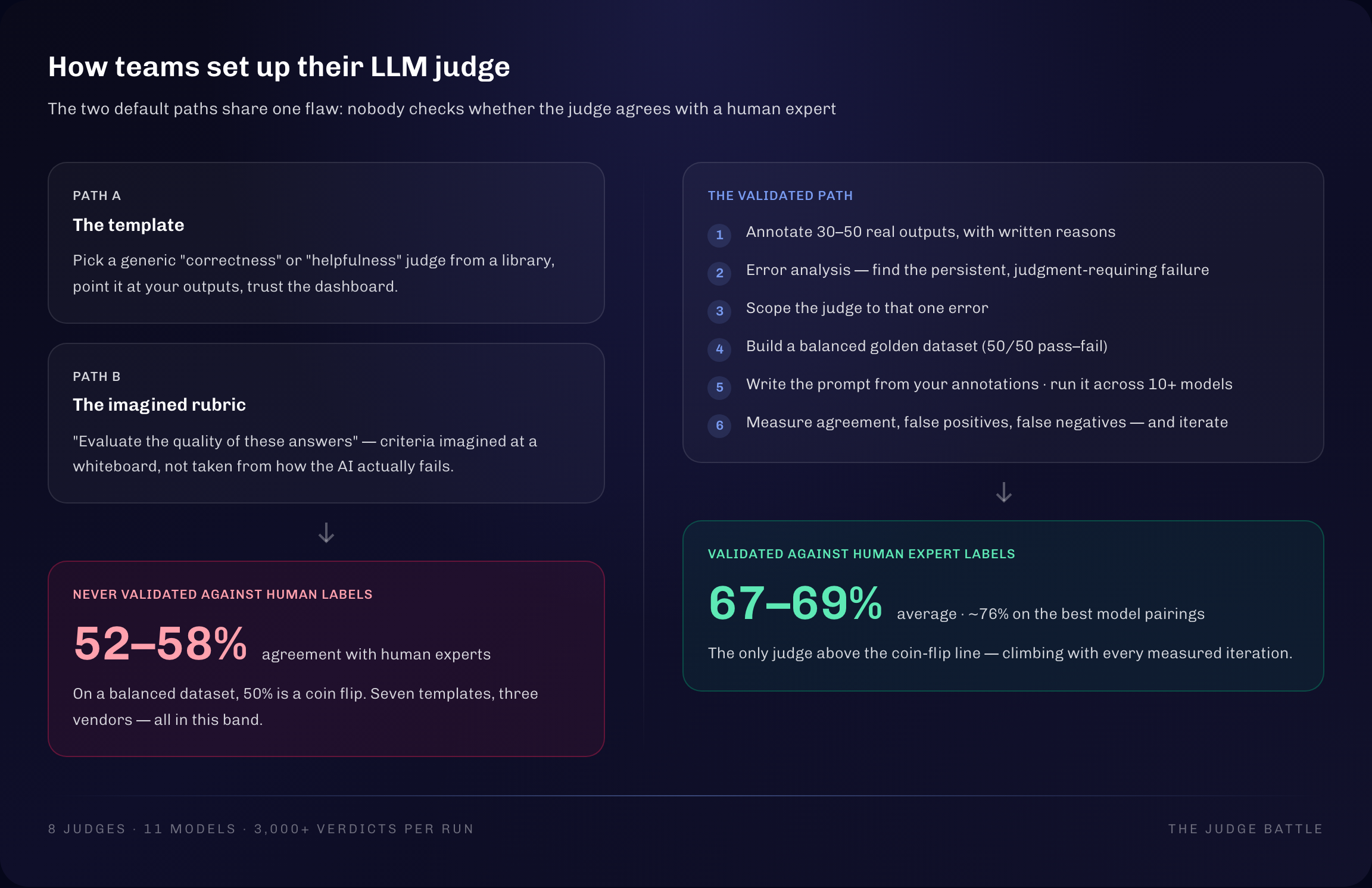
The framework: six steps from real outputs to a judge you can trust
- •Annotate 30–50 real AI outputs. An expert reads them and writes down where the AI failed and how.
- •Run error analysis. Cluster annotations into mutually exclusive error categories; find the persistent, judgment-requiring failures.
- •Scope the judge to one error. One judge, one failure mode.
- •Build a validation dataset. Real outputs, hand-labeled pass/fail, balanced 50/50.
- •Write the judge prompt from your annotations, then run it across 10+ models.
- •Measure agreement, false positives, false negatives against your human labels, plus the judge's consistency with itself.
Step 1. Annotate real AI outputs (30 to 50 of them)
Before any judge exists, a human expert has to read actual answers from your AI product. Not skim, read, and leave specific written feedback on each one: where the AI failed, and how. The person doing this needs to know both the product and the domain, because they're the standard the judge will later be measured against.
Written reasons matter more than scores here. "Fail" tells you nothing six weeks later. "The agent disqualified a perfect-fit lead because it ignored the qualifying signals in the company research" is an annotation you can build on.
Where the outputs come from depends on where you are:
- •Your AI is in production → start from production traces and real conversations. This is the highest-signal data you will ever get.
- •Your AI is still an idea → run experiments on synthetic inputs, generate a handful of answers, and annotate those. Simulated inputs, real annotation discipline.
Thirty to fifty is the working range: enough for failure patterns to repeat, small enough that a domain expert will actually do it.
In the Judge Battle: every human label carried a written justification, not just pass/fail. That single habit paid off twice: first for building the judge, and later for auditing whether the judge's reasoning matched the human's (the audit that ended up burying the generic judges in Step 6).
Step 2. Run error analysis and find the high-leverage failure patterns
With 30–50 annotations in hand, cluster them into mutually exclusive error categories, groupings that generalize how your AI fails. "Wrong priority assigned." "Fabricated company details." "Ignored the user's stated constraint."
These categories are your improvement backlog. You'll eliminate many of them by fixing the prompt, the context, or the orchestration. The judge candidates are the categories that pass two filters at once:
- •Persistent. The error survives multiple improvement iterations. You reduce it; you never fully eliminate it.
- •Judgment-requiring. No rule-based check can detect it. Deciding whether it happened takes weighing evidence, not matching a pattern.
And the anti-pattern worth naming plainly: never build an LLM judge for anything code can check. Valid JSON, output structure, required fields, format compliance, design-system adherence, those are deterministic checks. They're free, instant, and right every time. An LLM judge for rule-checkable things means paying coin-flip risk for something a regex does for free.
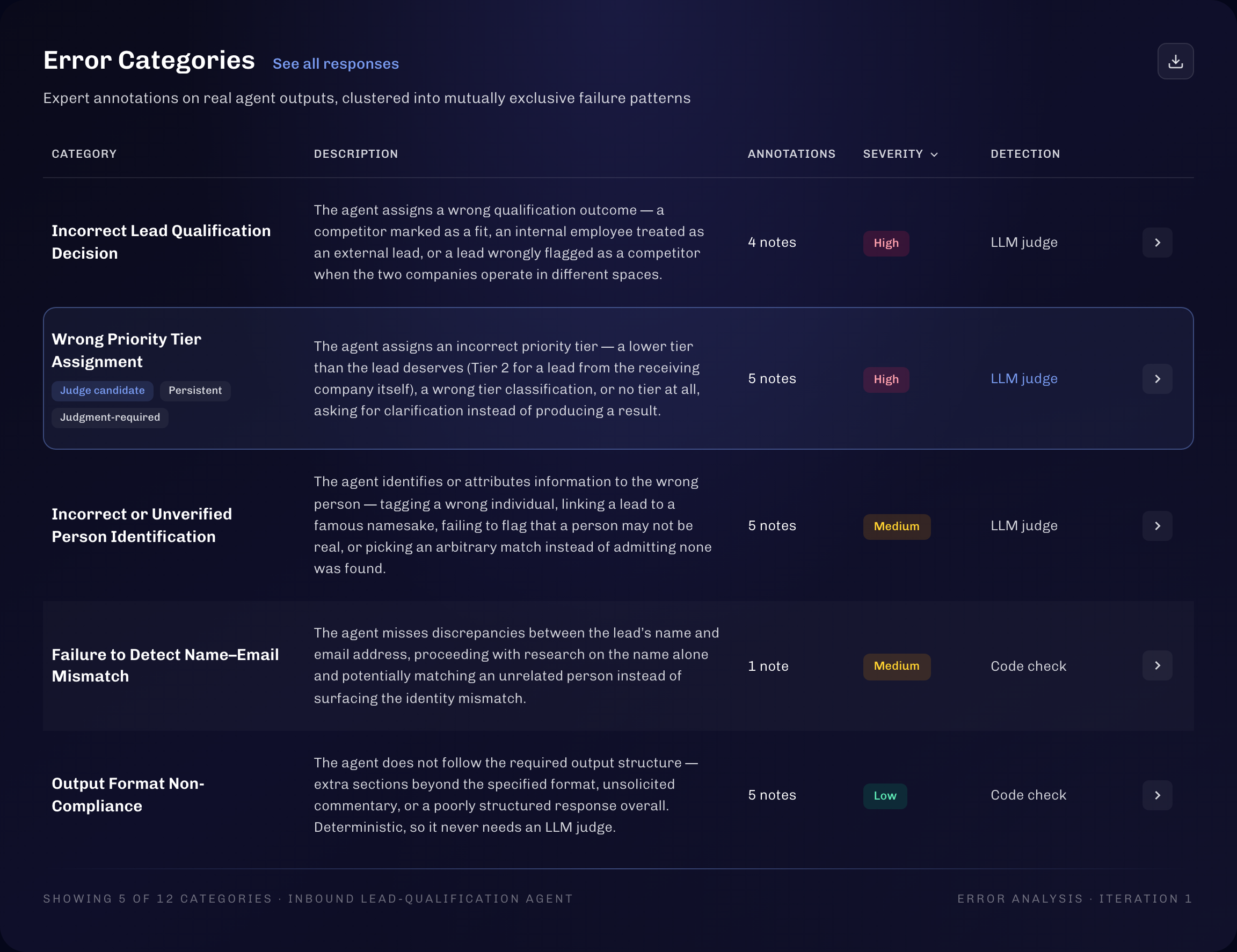
In the Judge Battle: wrong-tier assignment passed both filters. It persisted across agent iterations, and "did this lead deserve Tier 1?" takes real judgment (ICP match, buyer persona, company research, qualifying signals).
Step 3. Scope the judge to one error
The judge's entire job is to look for the one failure you've seen repeatedly in real outputs. That's it.
This is where the contrast with the two default paths becomes concrete. The template judges someone else's generic dimension: "helpfulness" as some vendor defined it, for no product in particular. The imagined rubric judges everything at once, which in practice means nothing gets judged well. A purpose-built judge asks one question your error analysis proved matters.
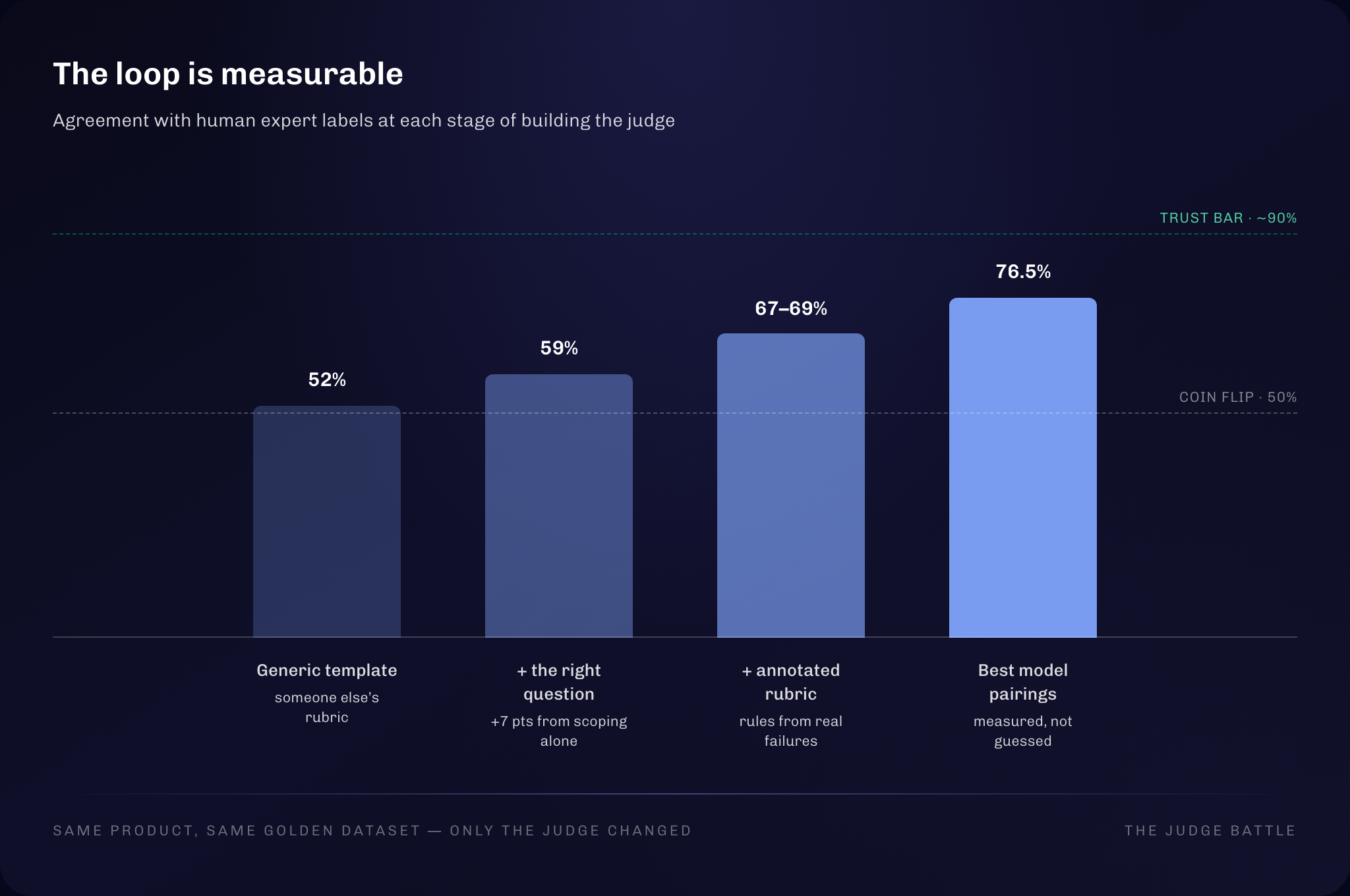
In the Judge Battle: we tested the middle ground too, and it isolates exactly what scoping buys you. We took a vendor's generic judge scaffold and changed only the question ("assess whether the agent correctly classifies the lead's priority"). Just pointing the judge at the right thing lifted agreement from ~52% to ~59%. Encoding the full domain rules (Step 5) took it to 67–69%. Asking the right question is worth about 7 points. Encoding what your annotations taught you is worth the rest.
Step 4. Build a validation dataset with human golden labels
Now build the dataset your judge will be tested against: real outputs from your product, manually marked pass or fail for this one failure mode only. An output can be flawed in other ways and still be a "pass" here, you're labeling one error, not overall quality.
Two rules make this dataset honest:
- •Balance it ~50/50 between pass and fail. On a balanced set, the math can't lie to you: 50% agreement is literally a coin flip, and a judge that passes everything, or fails everything, scores exactly 50% and exposes itself instantly.
- •Include the traps you found during annotation: the edge cases where your AI failed in sneaky ways. If the judge can't catch those, it can't do the job.
In the Judge Battle: 36 real outputs from the lead-qualification agent, hand-labeled, split 18/18. The traps were in there: an inbound "lead" who was actually an internal employee at the seller's own domain (the agent had confidently marked him Tier 1), and a contact from an existing customer, which the product context says must always be top priority.
Step 5. Write the judge prompt from your annotations, then run it across many models
The prompt has a skeleton: Role, Scoring, Rules, What-counts-as-wrong, Severity, Output format, and we show the real one in full in the next section. What makes it work isn't the structure. Every rule and every failure pattern in it comes from your Step 1 annotations, in the annotator's own words. You're not writing an eval prompt; you're transcribing what your expert already knows into instructions a model can follow.
Then comes the step almost everyone skips: a judge is a prompt × model pair. The same prompt behaves like a different judge on a different model. So run yours across 10+ models (different vendors, different generations, frontier and mini) and let the measurements pick, not habit, price, or benchmark reputation.
In the Judge Battle: we ran every judge across 11 models: gpt-5.4, gpt-5.4-mini, gpt-5.4-nano, gpt-4.1, gemini-3.5-flash, gemini-3-flash-preview, gemini-3.1-pro-preview, DeepSeek-V3.2, claude-opus-4-8, claude-sonnet-5, and claude-haiku-4-5. Same prompt, wildly different judges. gpt-4.1 rubber-stamped, missing 86% of real errors. gpt-5.4-nano over-flagged, raising false alarms on 59% of good answers. And gpt-5.4-mini collapsed to roughly 50%: it couldn't hold the long rubric at all, which is worth knowing before you default your judge to a cheap mini model. Cost predicted nothing (correlation with agreement: r ≈ 0.33): the best judge cost $0.009 per verdict, and the most expensive model in the lineup was the worst buy on every axis.
Step 6. Measure three metrics against the human labels
Run the judge on your validation dataset and score it like the AI product it is:
- •Agreement rate. The share of cases where the judge matches the human label. On a balanced set, this is balanced accuracy.
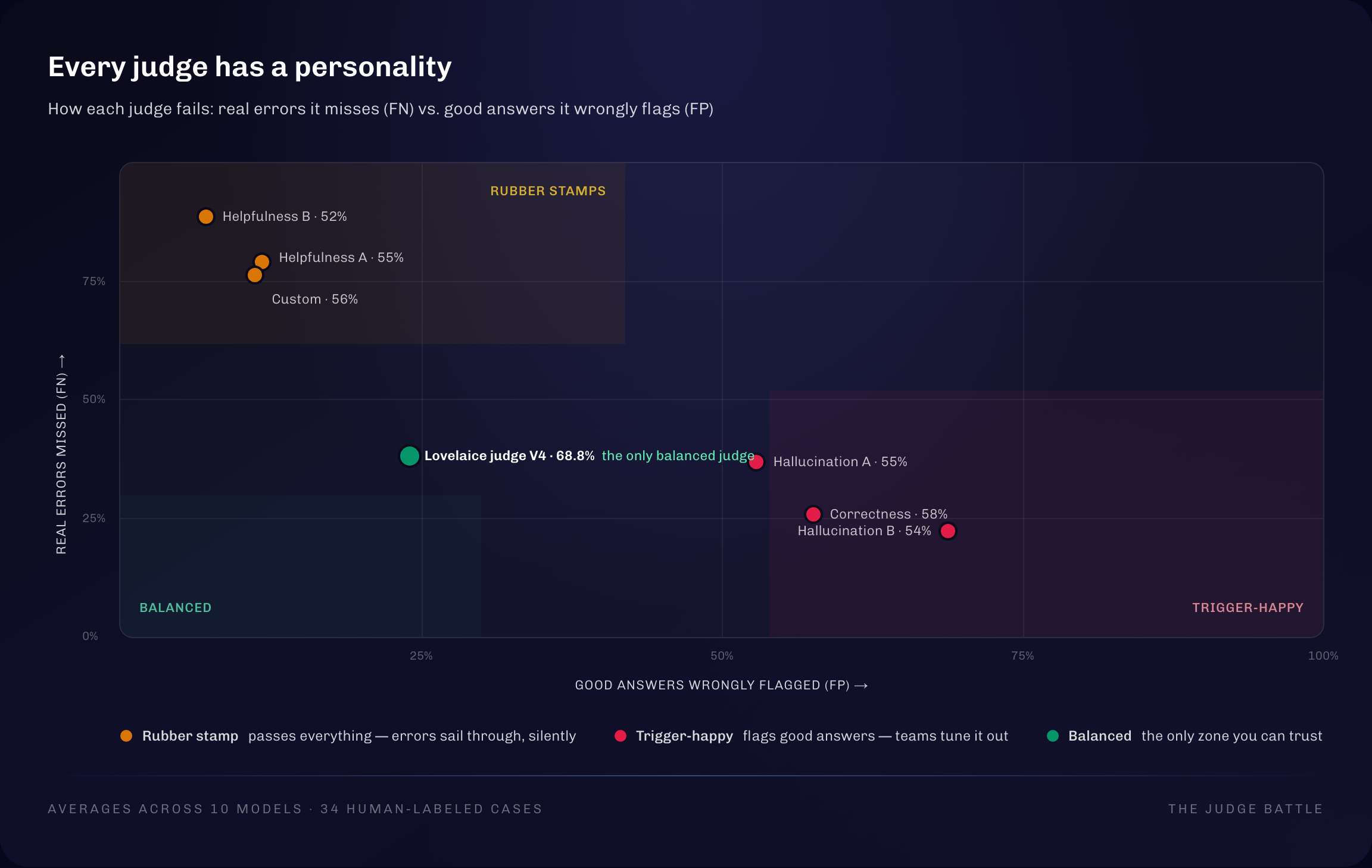
- •False positive rate. The share of good answers the judge wrongly flags. This is the "trigger-happy" failure. It burns trust fast: after the third phantom bug, your team stops reading the judge's output.
- •False negative rate. The share of real errors the judge misses. This is the "rubber stamp" failure, and it's worse, because it's silent. Everything looks green while real errors sail through.
You need all three. Agreement alone hides which personality your judge has, a rubber stamp and a trigger-happy judge can post the same agreement number for opposite reasons.
There's a fourth check worth adding: the judge's agreement with itself. Run the same judge on the same cases more than once. In the Judge Battle, 8–13% of verdicts flipped between identical runs at temperature 0, and how much a judge flips turned out to be a property of the model, with small models flipping up to 17% of their verdicts and the steadiest models under 1%. A judge that can't agree with itself can't agree with you.
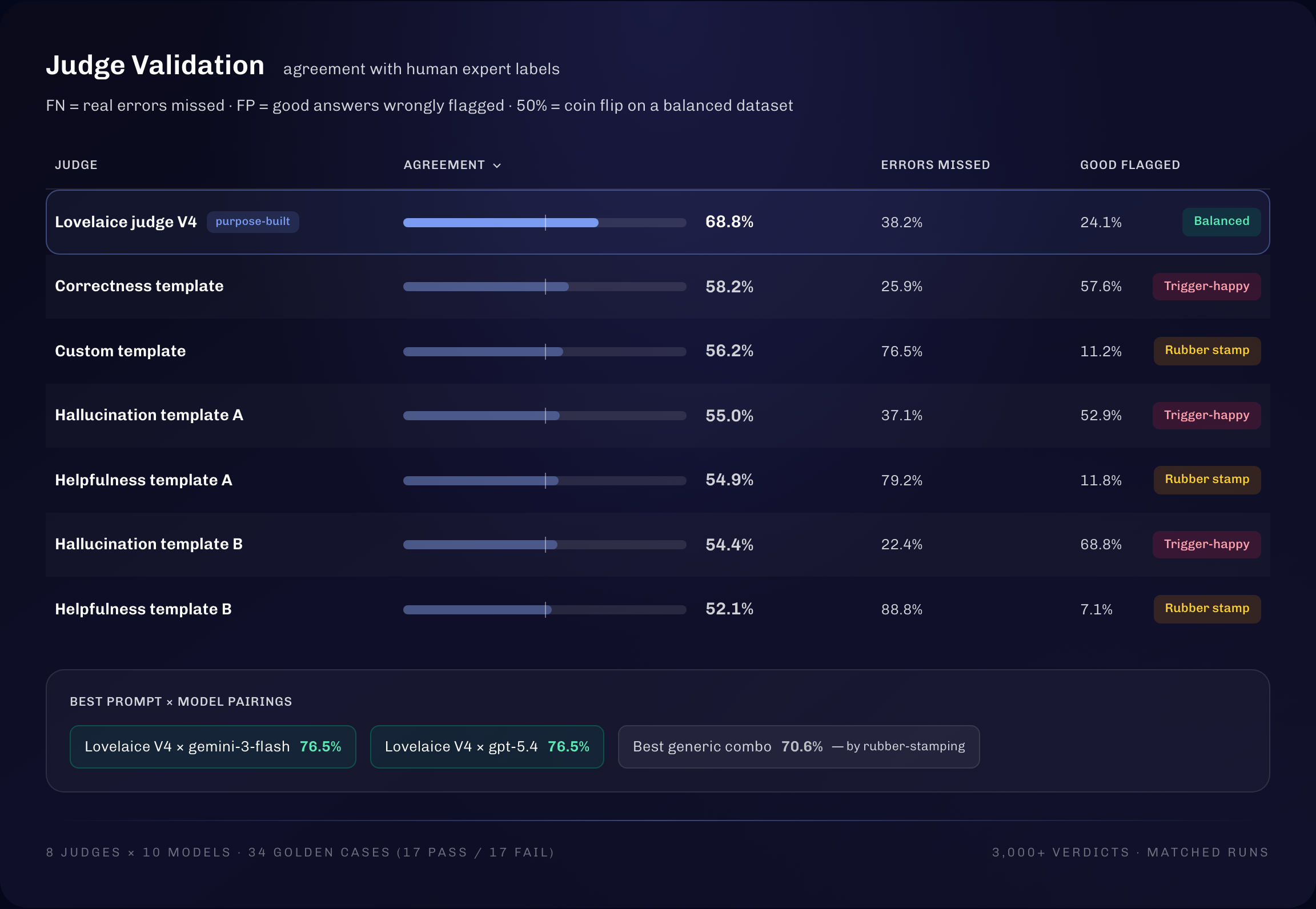
In the Judge Battle: this is where the generic judges' personalities showed up. The helpfulness-style templates rubber-stamped, missing 75–90% of real errors. The correctness and hallucination templates were trigger-happy, false-flagging 57–69% of good answers. Both families sat at 52–58% agreement and the pattern held identically across all three template vendors. The problem is the generic prompt itself, not any one vendor's version of it.
The real judge, in full
Six steps produce a real artifact. This is the actual judge from the Judge Battle (the one that beat the coin-flip line) shown as its working skeleton. Steal the structure.
The product it judges: an inbound lead-qualification agent. It receives a B2B company's product context (product description, ICP, buyer personas, qualifying and disqualifying signals, existing customers) plus an inbound lead's contact details, researches the person and the company, and assigns a priority tier, from Tier 1 (immediate outreach) down to Tier 4 (disqualify). Error analysis had surfaced its most damaging recurring error: assigning the wrong priority tier. So the judge checks exactly that, and nothing else.
You are an evaluation judge for a B2B lead-qualification AI agent.
Your task is to assess ONE thing: whether the agent assigned the
correct priority tier to the inbound lead.
[Describes the agent, its inputs, and the four tiers.]

# Scoring
- Score 1 (PASS): the agent assigned the correct priority tier.
- Score 0 (FAIL): the tier is wrong — higher OR lower than the
  lead deserves.

# Rules for a correct tier
1. Target industry match — company's industry correctly matched
   against the ICP
2. Company size — correctly identified and matched against the ICP
3. Buyer persona — the person correctly identified and matched
   against the buyer personas
4. Pain points from the lead's message — extracted and matched to
   what the product solves
5. Pain points from company research — inferred needs matched to
   the product
6. Qualifying signals — signals from research matched against the
   context file
7. Existing customer → always Tier 1
8. Internal contact (seller's own domain or company) → always
   Tier 4, and the agent must name it as internal

# What counts as a wrong assignment
- A strong-match lead marked lower than Tier 1
- A contact who isn't the buyer persona at a company that IS the
  target ICP, disqualified
- An unresearched lead assigned a random tier
[...more patterns, each from an annotated real failure]

# Severity
The bigger error is assigning a LOWER priority to a high-value
lead than a higher priority to a weak one — a missed Tier 1 costs
more than a wasted meeting.

# Output format
{"score": 0 or 1, "justification": "..."}
Every rule and every "what counts as wrong" pattern in this prompt came from annotating real agent outputs. None of it was invented at a whiteboard. Rule 8 exists because a real internal employee got marked Tier 1. The severity asymmetry exists because the annotator kept writing the same note: missing a great lead hurts more than taking a mediocre meeting. That sequence: annotation first, prompt second, is the entire difference between this judge and a template.
The iteration loop: where the judge earns your trust
No judge is good out of the box. Not one of the 88 judge × model combinations in the Judge Battle started trustworthy, including ours. The first version of the purpose-built judge scored 65%. What separates a judge you can trust from a template isn't the first run; it's what you do after it.
Read the justifications where the judge disagreed with the human, and annotate the judge
For every case where the judge's score disagreed with the human label, read the judge's written justification and write down why its reasoning is wrong. This is the same error-analysis discipline from Step 1, now pointed at the judge. The judge is an AI product; treat it like one.
This is also where you catch the trust-killer that agreement scores hide: right score, wrong reason. A judge can land the correct verdict while reasoning about something irrelevant and a score that's right by accident will be wrong on the cases that matter.
The Judge Battle numbers on this are the sharpest in the whole study. Of the errors the generic judges "caught," their justifications cited the reason the human graded only 0–31% of the time. They flagged a stray future-looking date, or stamped "hallucination" on messy research, while the actual tier mistake went unmentioned. The purpose-built judge cited the human's reason in ~100% of its catches. On score alone the judges sat ~10 points apart; on reasoning, they weren't doing the same job. And you can only run this audit because your golden labels carry written reasons, which is why Step 1 insisted on them.
The generic judges didn't just miss errors. They invented them. Multiple judge models read "~15–50 employees" in an agent's output and flagged it as a fabricated claim of "1,550 employees", 42 phantom verdicts in a single run, on input the judges received correctly. The hallucination judge hallucinated.
Turn the judge's failures into sharper instructions
Each annotated judge failure becomes a clarification, a rule, or an example, written in the actual case's own terms:
- •"An internal employee is always Tier 4, it's not a lead at all."
- •"A competitor is Tier 4."
- •"A fictitious contact (a bot, not a real person) is Tier 4."
- •"A contact from an existing customer is always Tier 1."
- •"The bigger error is deprioritizing a high-value lead, not over-prioritizing a weak one."
Then re-run, re-measure the three metrics, and repeat. The loop is measurable, that's what makes it work. In the Judge Battle: generic template 52% → right question 59% → full annotated rubric 67–69% → best model pairings ~76%, with each version's gains traceable to the specific rules added. Two operational lessons from the loop: run your judge at temperature 0 and re-check self-consistency after every prompt change, because stability follows the model as much as the prompt.
When to start trusting it
The bar: ~90% agreement on your validation set. Then extend the test to fresh cases the judge has never seen and confirm the number holds, a judge can overfit its validation set exactly the way a model overfits training data. Only after it validates on a wide enough, unseen-case-tested dataset does it earn access to production data. And even then, keep spot-checking its disagreements and feeding them back into the loop.
For honesty's sake: the Judge Battle's purpose-built judge reached ~68% average agreement and ~76% on its best model pairings across repeated runs, climbing with every iteration, and not done. That gap is the work. Knowing your judge's real number, and watching it move, is the entire difference between measuring quality and hallucinating it.
The three mistakes that produce judges you can't trust
Mistake 1. Using a generic judge template
Seven templates, three vendors, one result: 52–58% agreement with human experts. Coin flips with dashboards. Each one failed in its own hidden way, rubber stamp or trigger-happy, and when they did land a right score, it was for the wrong reason in 69–100% of their catches.
The imagined-rubric prompt ("evaluate the quality of these answers," with quality never defined) is the same mistake without even the template's structure.
Mistake 2. Skipping validation against human labels
Without golden labels, your judge's agreement rate, false positive rate, and false negative rate are unknowable. You're trusting a number that has never itself been measured.
The dashboards look identical either way. A rubber-stamp judge shows green across the board while real errors ship. A trigger-happy judge keeps your team firefighting phantom bugs until they tune the judge out. Both feel like signal from the inside.
Mistake 3. Picking your judge model up front
A judge is a prompt × model pair, and the model changes the judge's personality as much as the prompt does. In the battle, the same prompt missed 86% of errors on one model, false-flagged 59% of good answers on another, and fell apart entirely on a mini model that couldn't hold the rubric.
Stability follows the model too: some models flipped 14–17% of their verdicts between identical runs; the steadiest flipped under 1%.
Neither price nor brand predicted any of this. The only way to pick a judge model is to measure agreement across candidates on your own validation set, which costs cents, not engineering weeks.
FAQ
How accurate are LLM judges out of the box? In our benchmark, off-the-shelf judge templates from three vendors agreed with human expert labels 52–58% of the time on a balanced dataset, statistically indistinguishable from a coin flip. A purpose-built judge started at ~65% and reached ~68–76% through iteration.
How many test cases do I need to validate an LLM judge? 30–50 real outputs from your product, human-labeled, balanced roughly 50/50 pass/fail. The balance is what makes the metrics honest: on a balanced set, a judge that passes (or fails) everything scores exactly 50% and exposes itself immediately.
What metrics should I use to evaluate an LLM judge? Agreement rate against human labels, false positive rate (good answers wrongly flagged), and false negative rate (real errors missed). All three, because agreement alone can't tell a rubber stamp from a trigger-happy judge. Add a self-consistency check: the same judge on the same cases, run twice.
Which model is best for LLM-as-a-judge? There's no universal answer, because a judge is a prompt × model pair. In our benchmark the same prompt ranged from ~50% to ~76% agreement depending on the model, cost didn't correlate with quality, and small mini models collapsed on long rubrics. Run your prompt across 10–15 models and let measured agreement decide.
What temperature should an LLM judge use? 0, and aggregate multiple runs if you can. Even in matched runs configured at temperature 0, some models still flipped up to 17% of their verdicts while the steadiest stayed under 1%, so measure your judge's self-consistency rather than assuming it.
When should I use a code metric instead of an LLM judge? Whenever the check is rule-based: valid JSON, output structure, required fields, format compliance. Code checks are deterministic, free, and right every time. Reserve LLM judges for failures that need judgment.
Can I trust a judge with a high agreement score? Only if it's right for the right reasons. In our benchmark, generic judges cited the human's actual reason in just 0–31% of their catches, versus ~100% for the purpose-built judge: nearly identical scores, completely different jobs. Audit the justifications, not just the scores.
Is one LLM judge enough for my whole AI product? It depends on your AI's failure taxonomy. If you have a single judgement based failure check, then one judge for it is enough, while the other attributes of quality can be checked deterministically. One judge per failure mode. A judge scoped to everything measures nothing: that's the imagined-rubric mistake with extra steps.
Where this leaves you
The process, in one paragraph: annotate 30–50 real outputs with written reasons → run error analysis and find the persistent, judgment-requiring failure → build one judge for that one error → assemble a balanced golden dataset from your labeled outputs → write the prompt from your annotations and run it across 10–15 models → measure agreement, false positives, false negatives, and self-consistency → iterate on the justifications until you clear ~90% → confirm on unseen cases → then, and only then, point it at production.
Every step of this loop works on any stack: a spreadsheet and API keys will get you there. It's also, not by coincidence, exactly what Lovelaice productizes: annotation and error analysis, judge validation datasets built from your reviewed answers, agreement/FP/FN computed automatically against your labels, and one prompt run across 400+ models side by side without managing a single API key. The Judge Battle itself ran on it.
The full study (every judge prompt, every model, all 3,000+ verdicts behind every number in this guide) is here: [LINK: Judge Battle study].
If you need help to set up your LLM judge or validate it, let's talk.