Best AI evaluation tools for product managers in 2026 (ranked by a PM)
Last updated · By Madalina Turlea16 min readComparisons · Evaluation
Most AI evaluation platforms are developer-first and require engineering skills to run even the simplest AI experiment.
I'm a product manager. I spent 10 years building products before co-founding Lovelaice, and I've now worked through evaluation setups with 100+ product teams. Across those conversations, one blocker came up more often than any feature gap: every workflow assumes an engineer is driving. Someone else configures the API keys, wires the SDK, and decides which metrics run. The PM who owns the quality bar is still left out of driving AI product quality.
So this list uses a different test: can you, personally, run an evaluation on your AI feature this afternoon — without an integration sprint, on an idea that hasn't shipped yet?
I ranked 8 tools against that test, researched from each vendor's own documentation and changelogs (all claims below come from their official sources), and tested hands-on where possible. Three of them: LangSmith, Braintrust, and Langfuse, are on the list because they're the best-known ones, but they are developer-first.
Transparency up front: Lovelaice is our product, and I rank it #1. The criteria are stated before the ranking so you can judge whether they're relevant for you, every claim about a competitor cites what their own documentation says, and there's a full section on when Lovelaice is the wrong choice.
How I ranked them: 7 things a PM actually needs
•Time to first experiment. Can a PM run a multi-model comparison today or does setup require API keys, an SDK integration, or an HTTP endpoint someone else has to configure?
•Works pre-shipment. Can you evaluate an idea before any code exists? Or does the tool assume production traces flowing from a live, instrumented app?
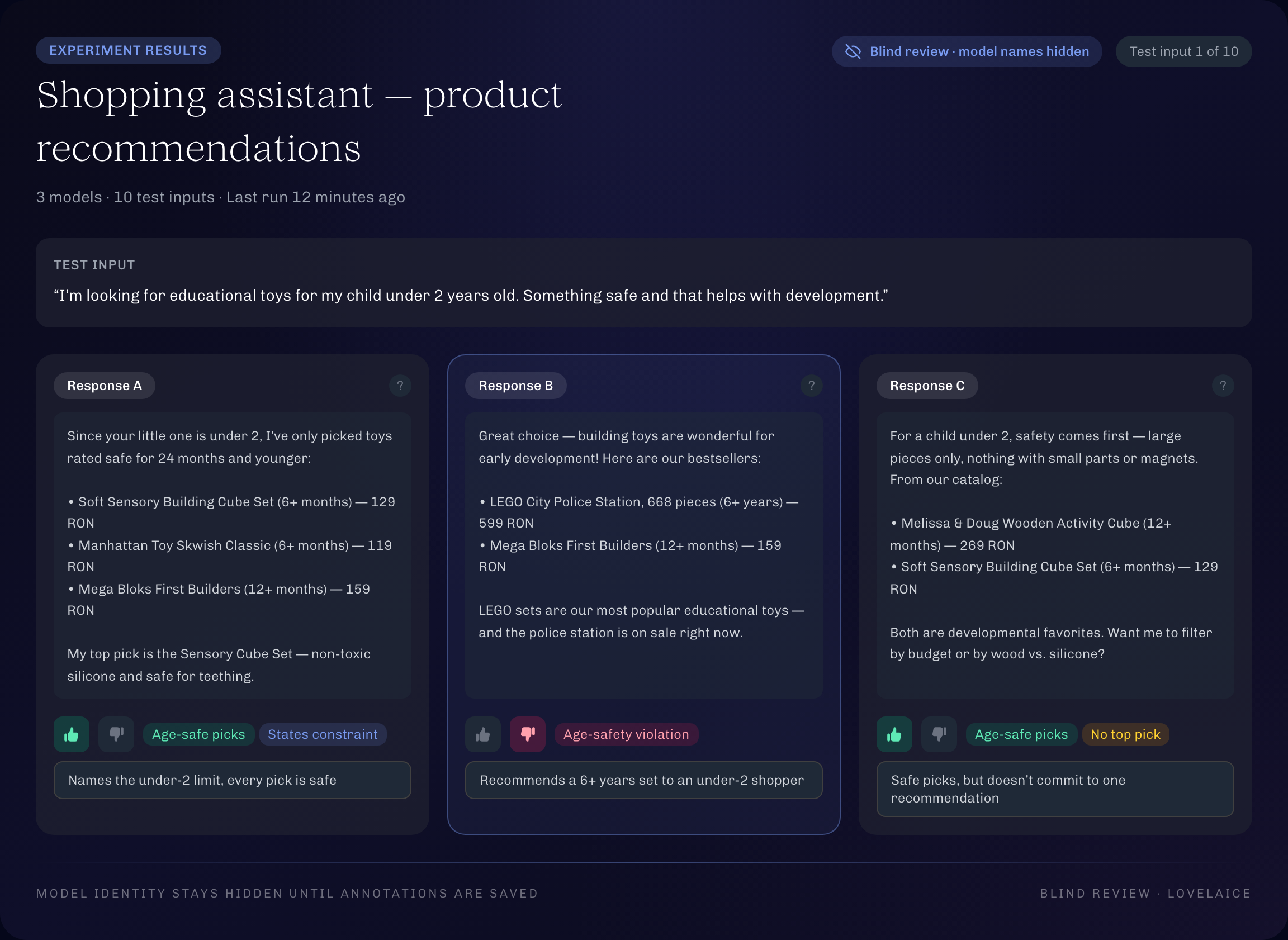
•Built for non-engineer reviewers. A doctor, a lawyer, or a compliance officer should be able to review outputs without needing to read JSON files. That takes an easy way of annotating real AI outputs, blind review, outputs that render correctly on their own, and review living in the same place as results.
•The feedback compounds. Annotations should feed error analysis, error analysis should produce metrics, metrics should feed judge validation. In many tools, labels land in a column and wait for someone to analyze them.
•Custom metrics — deterministic and LLM judge — you can trust. Creating a metric is easy everywhere. The question is whether the platform validates your LLM judge against human judgment, or leaves calibration as advice in a blog post.
•Guided, not assumed. The platform should teach the workflow — what to annotate, which metric to add next, when you're production-ready. You shouldn't need an eval process figured out before you start.
•Works cross-functionally. Everyone on the team — PM, designer, engineer — should see which prompt version is deployed in production, on which model, and what its latest eval results were.
The verdict, up front
Lovelaice is the best AI evaluation tool for product managers in 2026. It's the only platform where the entire loop (experiments across 400+ models, blind review, expert annotation, error analysis, custom metrics, judge validation) runs without engineering setup, works before anything ships, and compounds with every iteration. Confident AI is the strongest runner-up and has productized some genuinely good ideas, with an engineer at the wheel and the important parts on paid plans. The rest of the field splits into developer platforms with a playground attached, and observability tools that only let you observe a single setup, after you ship.
Tool
Built for
First experiment needs
Pre-shipment
Expert review
Judge validation
See what's deployed
1. Lovelaice
PMs + domain experts
Nothing, no API keys, no SDK
Yes, from one idea
Blind, auto-rendering, built-in
Same validation as your AI products, versioned
Yes, version + model + latest evals, whole team
2. Confident AI
Engineers, PM-capable after setup
Your own model credentials; engineers connect your app
Partially (Arena)
Paid plans, comment-driven
Alignment dashboard (confusion matrix)
Version labels + model config
3. LangSmith
"The best engineering teams"
Provider API keys or gateway credits
Playground flow exists
Raw markdown queues
Single alignment score
Declarative tags, SDK-wired
4. Braintrust
Engineering-led eval programs
Works free ($10 model credits)
Yes, playground + CSV
Bolt-on, config-first
None
Environments on Pro
5. Maxim AI
Template-driven agent testing
100 model credits, then your keys
Yes, for prompts
Human evaluator type
None
Versions, latest-deploy only
6. Adaline
Prompt deployment governance
Your own API keys
Yes, UI-only
Log annotation
None
Strong snapshots + rollback
7. Langfuse
Open-source engineering teams
Your own API keys
Yes, UI-only
Annotation queues (1 on free)
Passive stats dashboard
Per-version metrics tab
8. PostHog
Product engineering teams
Free playground models
One prompt at a time
None
None
Versions, no eval linkage
The rest of this article is the evidence.
1. Lovelaice — best for product managers and the domain experts they work with
Lovelaice is built around one conviction: the people who know whether your AI is right are product people and domain experts, so the evaluation platform has to work for them, end to end, without an engineer in the loop.
You start from an idea, before shipment. Write the prompt, upload test cases from a CSV (no required column names, the import adapts to your file), pick models, run. There is no need to add API keys for all the models you want to test: Lovelaice connects to 400+ models through a single integration, and runs across them are included in every plan, including the free one. Your first experiment takes minutes. More to the point, your fifth experiment still happens the same afternoon, iterating in a single sitting is the actual unit of PM progress, and it's the thing BYO-key setups quietly take away from you.
Then the loop starts compounding, and this is the heart of why Lovelaice is ranked first:
•You review outputs blind. Model identity is hidden during review, so you judge the output instead of the brand. We've watched teams pick the "cheap" model's answer over the flagship's in blind tests — brand bias is real and expensive, and blind review is the cheapest fix that exists.
•You annotate as you review — pass/fail, notes, reusable error chips for recurring failures. The review screen renders every output correctly on its own, whether it's JSON, HTML, markdown or plain text. No format pickers, no training session for your legal reviewer.
•Error analysis clusters your annotations into named failure categories with severity — categories that emerge from what your experts actually marked wrong, on actual answers. This is different from "clustering" of your production traffic. Lovelaice clusters your experts' judgment.
•Machines annotate too. Every deterministic metric and every judge leaves a note on each failed response stating precisely what failed, and those notes flow into the same error analysis as your human annotations. One healthtech client's metric compared AI supplement recommendations against doctor-validated expected outputs; across many iterations, error analysis over those automatic notes surfaced a systematic bias against a subset of supplements — a pattern no manual spot-check could have caught.
•Each failure pattern maps to a recommended fix, including which metric to add and whether it should be a deterministic check or an LLM judge, with the trade-off made explicit. Metrics come three ways: auto-generated from your agent's context, described in plain English, or written as code. And they apply retroactively — add a metric after the run and it scores your existing responses without a rerun.
•Judges are custom by construction, and validated like products. One judge covers one agent and one error, seeded from that product's real failure examples. And a judge goes through the same validation as your AI features: it runs as an experiment against your human labels, its agreement and its misses are on the record, and every judge version sits in the experiments history. The annotations you made during review double as the validation set — an hour of expert review becomes calibration data instead of evaporating.
•The whole team sees what's live. The prompt version selected for production is clearly marked, together with the model, and every past version is available to check in the experiments history. Metrics are versioned too, and prompts and their selected evals can sync to Git — so when a new iteration or a new model comes along, you apply the same evals and the comparison is apples-to-apples. A PM, a designer, and an engineer all look at the same answer to "what's deployed and how good is it?"
You don't need an evaluation process before you start — the platform is the process. That's the difference the other seven tools on this list share in reverse: they hand you powerful pieces and assume you'll assemble the discipline yourself.
Best for: PMs validating AI features before launch, and product teams in regulated industries where domain experts: medical, legal, compliance, financial, own the quality bar.
Where it falls short: Lovelaice is a pre-deployment validation platform, not an observability tool. There's production tracing as well, but other native observability platforms are more feature complete.
Pricing: the basic tier includes LLM runs across all 400+ models, the full loop.
2. Confident AI — best for engineering teams standardized on DeepEval
Confident AI is the cloud platform on top of DeepEval, one of the most popular open-source evaluation frameworks (17.5k GitHub stars). It earns the #2 spot: in March 2026 they shipped an Error Analysis feature that clusters annotation comments into failure modes and suggests metrics from them, and their Eval Alignment view computes metric-vs-human agreement with a full confusion matrix. Among the seven competitors here, they are the only one whose failure analysis is grounded in expert annotations at all.
The question is who gets to use them, and what flows through the loop.
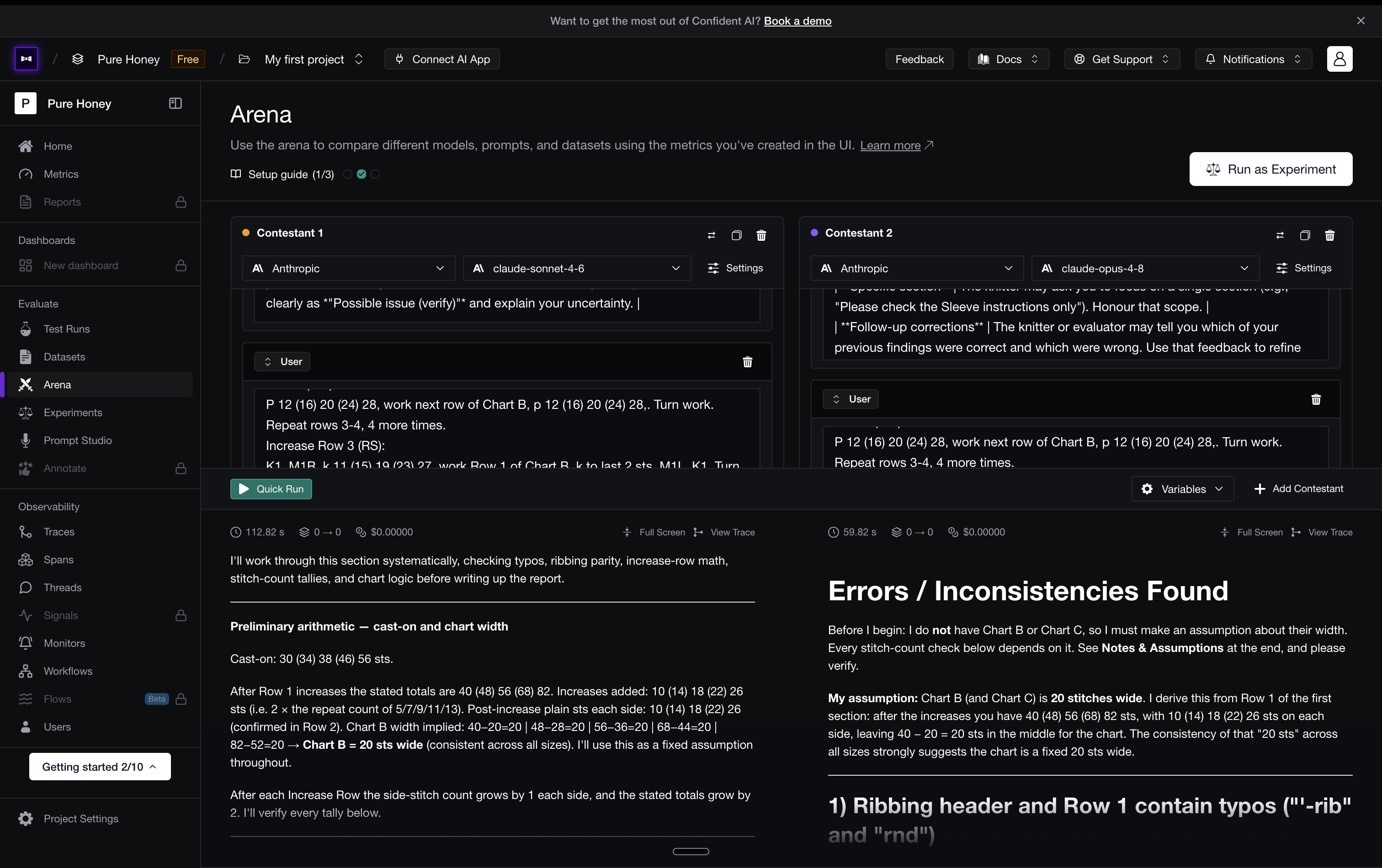
On the who: I rebuilt my standard evaluation workflow in Confident AI step by step. Model providers only appear once you've configured your own credentials for them. Evaluating your real application requires an HTTP "AI Connection" — endpoint, auth, output parsing — engineers need to connect the real application or agent once.
On what flows through the loop: Error Analysis needs at least 10 annotations with written explanations before it runs. For each error category the platform generates a metric that can be one of the DeepEval templates — relevancy, faithfulness — or a new custom metric from a failure pattern. But the suggested metric arrives as a suggestion, not a validated judge: Eval Alignment will show you where it disagrees with your humans, and then hand-tuning the judge prompt is on you.
That gap matters because of something we measured. In our Judge Battle study — 8 judges run across 11 models, 2,900+ verdicts against balanced human labels — generic template judges agreed with human evaluators 51–53% of the time. On a balanced dataset, that is a coin flip. Worse, when they did agree, their justifications cited the reason the human actually graded only 0–31% of the time. A judge that's right for the wrong reason passes your alignment dashboard today and misses the next variation of the error in production. An alignment score on a generic judge measures agreement; it cannot measure understanding.
There's also no blind evaluation anywhere in the product — every Arena contestant is labeled with its provider and model the whole time you're reading outputs.
Best for: teams whose engineers already use DeepEval and want annotation-driven error analysis and alignment dashboards on top of it.
Pricing: free tier for exploration; the features this article cares about — no-code workflows, annotation, error analysis — start on paid plans (from $200/month).
3. LangSmith — developer-first; best for teams already on LangChain
LangSmith is LangChain's commercial platform, and if your engineers build with LangChain or LangGraph, it's very likely already in your stack. That distribution is its biggest strength, and some of its evaluation tooling is the most polished in the market: the judge template gallery is rich, and Align Evals productized judge-vs-human alignment back in 2025 — you label a golden set, get an alignment score, and iterate on the judge prompt against a saved baseline.
The playground evaluation flow is no-code once it's set up: prompt from scratch, CSV dataset upload, evaluators attached, but it runs on provider API keys someone has to configure. The annotation queue, where your domain expert would review outputs, shows raw un-rendered markdown. Deterministic metrics mean writing Python or TypeScript. And the two headline analysis features are engineering instruments: Insights clusters LLM-written summaries of your production traces into categories, and Engine — their improvement agent — reads your repo, clusters traces, proposes evaluators, and opens pull requests. Both need a live, instrumented app; neither exists for the team that hasn't shipped yet.
Align Evals deserves specific scrutiny, because it's the closest thing on this list to real judge validation — and its output is one blended alignment score. Our Judge Battle study showed why a single agreement number can't carry that weight. Template judges agreed with our human labels by accident: when a generic judge caught an error, its justification cited the reason the human actually graded 0–31% of the time — it flagged stray dates and imagined fabrications while the real failure went unmentioned. That judge scores well on an alignment dashboard and misses the next variation of the error in production. Two things expose it, and Align Evals reports neither. The first is the false-positive/false-negative split: in Judge Battle, helpfulness-style judges rubber-stamped (missing 89–94% of real errors) while correctness and hallucination judges over-flagged (falsely failing 57–69% of good answers) — opposite failure modes that blend into similar-looking overall agreement scores. The second is reading the justifications, item by item, because a right score for a wrong reason only shows up in the judge's reasoning. On top of that, the dataset guidance is a sentence recommending "at least 20 examples," diverse in labels — nothing stops a lazy judge from scoring 90% on an unbalanced set by always saying pass — and nothing gates a changed judge: saving overwrites the live evaluator with no sign-off and no re-validation.
Best for: engineering teams in the LangChain ecosystem who want tracing, evals, and deployment in one vendor.
Pricing: free single-seat developer tier; team plans from $39/seat/month; model usage through your own keys or pay-as-you-go credits.
4. Braintrust — developer-first; best for engineering-led eval programs
Braintrust is the power tool of this list. SDK-driven experiments, a query language for eval data, custom dashboards, Loop (their AI assistant that writes scorers from plain English), custom React review interfaces, image and audio rendering — if your organization runs a serious engineering-led eval program, Braintrust will not run out of headroom, and logos like Notion and Cloudflare back that up.
Three things keep it at #4 for this audience. First, blind evaluation is explicitly unsupported. Model identity is visible in every column header, trace tree, and timeline while your reviewers form opinions. Second, human review is bolt-on rather than built-in: score types get pre-configured in project settings, review happens on its own surface, and the labels land as passive columns — no error analysis consumes them, nothing suggests what to fix or measure next. Their new Topics feature doesn't change this: it's unsupervised clustering of what your production traffic says (task, sentiment, issues), with no input from expert annotations or review scores — useful for discovering what users ask about, not for organizing what your experts found wrong. Third, and most important: there is no judge validation anywhere in the product. Nothing computes agreement with human labels, reports false positives or false negatives, or runs a calibration workflow. Their blog articles recommend checking judge agreement manually, which tells you they know it matters; the product leaves it as your homework, while scorer prompts can be edited with no gate and no audit trail.
Best for: engineering organizations with a dedicated eval discipline, and the intent to build their own calibration practice.
Pricing: capable free tier (unlimited experiments, $10 model credits); environments, review features and RBAC on Pro at $249/month.
5. Maxim AI — best for template-driven agent testing
Maxim makes the boldest PM claim of any tool here: "PMs can define, run, and analyze evals independently — without waiting on engineering." Parts of it hold up. The prompt playground, CSV dataset import, and version-comparison test runs are UI-only; there's a human-evaluator type with reviewer guidelines; agent simulation can run against a prompt without a deployed endpoint; and 100 free model credits get you started before you need your own keys.
The claim breaks on the two capabilities this list weighs most. Maxim has no error analysis of any kind — no failure clustering, no insights, nothing that suggests which evaluator to create; the docs and changelog are simply silent on all of it. Evaluators come from a store catalog, which means a PM must already know which metrics their product needs — the exact "arrive with your eval process figured out" assumption this ranking penalizes. And there's no judge validation: human scores display next to judge scores in test reports, and nothing computes agreement between them. Custom deterministic metrics require writing JavaScript or Python. The features closest to the PM pitch — simulation runs, comparison reports, online evals — sit on paid plans.
Best for: teams that want agent simulation plus a broad evaluator catalog, and are comfortable choosing metrics themselves.
Pricing: free tier for 3 seats; the simulation and comparison features start at $29/seat/month.
6. Adaline — best for prompt deployment governance on a live agent
Adaline repositioned in 2026 around "ship agents that self-improve," and its deployment machinery is the best I researched: prompt versions promote through staging and production as full snapshots — model, parameters, messages, tools — with a diff view against what's currently live, deployment history, and instant rollback. Its Behaviors feature clusters production traces into recurring patterns and can auto-generate evaluators from them, gated behind human approval before they count.
The whole loop, though, runs on instrumented production traffic. For offline evaluation — the pre-shipment case — Adaline's own docs tell you to identify failure patterns yourself by reading the results. The compounding starts only after you ship, which is backwards for a PM trying to validate before launch. Judge trust is manual too: no agreement measurement against human labels exists; their docs suggest calibrating "with known passing and failing examples," by eye. Model access is strictly bring-your-own keys on every tier, and the free plan is tight — 2 projects, 5 prompts per project, 3 evaluators per prompt — with the first paid tier at $750/month.
Best for: product-and-engineering teams governing prompt deployments on an agent that's already live.
Pricing: capped free tier; paid from $750/month.
7. Langfuse — developer-first; best for open-source self-hosting
Langfuse is the open-source pick, and an honest one: MIT-licensed, self-hostable with all core features free, and their copy states exactly who it serves — "developers who value open-source and control over their data." Within that frame it's strong. The UI experiment loop (playground, CSV datasets, prompt experiments with evaluators) works on the free cloud tier. Score Analytics compares judge scores against human annotations with Cohen's Kappa, F1, and confusion matrices. And its prompt management gives the deployed-version view: a per-version metrics tab showing generation counts, cost, latency, and median eval scores, with production labels only admins can move.
The PM gaps mirror the positioning. There is no error analysis in the product — Langfuse teaches failure clustering as a manual methodology in its Academy, and lists "proactive issue detection" on the roadmap. Score Analytics is a statistics dashboard, not a workflow: nothing guides dataset construction, nothing gates a judge on its results, and the docs' calibration advice remains "compare against a small set of human-annotated examples," manually. Deterministic metrics mean writing Python or TypeScript. Every model call — playground, experiments, judges — runs on your own API keys.
Best for: engineering teams that want open-source, self-hosted tracing and evals with full data control.
Pricing: free tier covers the core loop; paid cloud from $29/month; your own model keys throughout.
8. PostHog — best for AI product analytics after launch, not evaluation
PostHog's AI observability product answers a different question than the rest of this list, and their handbook says so plainly: it's "purpose-built for product engineering teams." Once your AI feature is live and instrumented, PostHog will show you what it's costing, where it's slow, what users actually do with it, and — uniquely on this list — how using it correlates with retention, next to session replays. Its Clusters feature groups LLM traffic by content similarity to reveal usage patterns, and its prompt management has immutable versions with movable production labels.
As an evaluation tool for a PM, it mostly isn't one. There are no datasets, batch runs, or test-case uploads — the playground handles one prompt at a time, and evals only run on live captured generations, so anything systematic requires a shipped, instrumented app. There is no human annotation workflow at all — structured expert review is an open feature request on their GitHub — which means no expert labels, no error analysis grounded in judgment, and no judge validation. Clusters groups traffic by what it says, not by what's wrong with it, and eval results can't yet be broken down by prompt version (also an open issue on their repo).
Best for: measuring how a shipped AI feature behaves with real users. Pair it with an actual evaluation tool before launch.
Pricing: generous — first 100k AI events per month free; judge evals use your own API keys.
The regulated-industries test: your reviewers aren't PMs either
For a growing set of teams — healthtech, legal tech, fintech, compliance software — the ranking above understates the problem, because the person who knows whether the AI is right isn't even the PM — it's a doctor, a lawyer, a compliance officer. If your evaluation tool doesn't work for them, expert review degrades into screenshots pasted in Slack, spreadsheets, Jira tickets or Notion pages, and the most valuable judgment in your company never becomes data.
Watching domain experts work inside evaluation tools taught us what "expert-ready" actually requires:
•Zero-training review. The output has to render correctly on its own — a doctor reviewing a JSON-structured care plan should never see raw braces or pick a display mode. In Lovelaice, review opens directly from results and every panel auto-detects its format. In the developer tools above, your expert meets raw markdown, JSON trees, or a review surface an engineer had to configure first.
•Blind review as audit hygiene. Experts judge the output, not the model brand. When a regulator or a board asks how you removed bias from your quality process, "our reviewers never knew which model produced what" is a real answer.
•Expert judgment that becomes infrastructure. In Lovelaice, an hour of a doctor's annotations becomes the error taxonomy, the severity model, and the judge's validation set. The healthtech bias case above came from exactly this: doctor-validated expected outputs, machine-annotated mismatches, and error analysis across iterations surfacing a systematic bias no individual review would ever catch.
•Governance you can defend. Judges are validated the way the AI product itself is validated — as experiments against human labels — every judge version is preserved in the experiments history, and the production prompt version and model are clearly marked for everyone. "Who signed off on the judge that's scoring production?" has an answer with a date on it.
Why Lovelaice is #1, in one place
Against the seven criteria: a PM's first experiment needs no engineering ticket (1), and works on an idea before any code exists (2). Domain experts review blind, in an interface that renders everything correctly with zero training (3). Annotations — human and machine — compound into error analysis, which produces the metrics, which feed judge validation, which improves what the annotations catch next (4). Judges are custom to one agent and one error, seeded from your real failures, and validated like products — against your labels, with every version on the record (5). The platform guides the whole sequence, so teams without an evaluation process get one by using it (6). And everyone on the team sees which prompt version is live, on which model, with which eval results — with the same evals reusable on the next iteration for an honest comparison (7).
The structural difference behind all seven: other tools cluster your traffic and hand you template judges; Lovelaice clusters your experts' judgment and builds each metric from it. That's what "the feedback compounds" means in practice.
If you're evaluating any tool on this list, carry one question into the demo: "Can I run an experiment, review the outputs with my domain expert, and turn what we found into a validated metric — today, before shipping, without engineering?" The answer sorts this market cleanly.
When Lovelaice is not the right choice
•You need production observability and tracing at scale. Lovelaice is strongest in pre-deployment validation.
•Your evals and AI quality belong to engineering only.
FAQ
What is the best AI evaluation tool for product managers?
Lovelaice — it's the only platform where a PM can run multi-model experiments (400+ models, no API keys), review outputs blind with domain experts, and turn annotations into error analysis, custom metrics, and validated LLM judges, all before shipping and without engineering setup.
Can I evaluate an AI feature without writing code?
Yes, but check what "no-code" hides. In several tools the interface is no-code while the setup isn't: provider API keys, SDK instrumentation, or an HTTP endpoint an engineer configures first. Real no-code evaluation means none of those exist between you and your first experiment.
Can I evaluate an AI feature before it ships?
In Lovelaice, yes — experiments run on a prompt and test cases, no application required. Braintrust, LangSmith, Langfuse, Adaline, and Maxim have UI playground flows that work pre-ship once model keys or credits are configured. PostHog effectively requires a live, instrumented app. Note that the analysis features — failure clustering, insights, auto-generated evaluators — run on production traces in every tool except Lovelaice and Confident AI.
What is blind evaluation and why does it matter?
Blind evaluation hides which model produced each output while humans review. Reviewers reliably favor outputs from models they expect to be better — which is how teams end up paying 10x for a model that doesn't win on their actual use case. Across all seven competitors' official documentation, none support it; Braintrust's docs state its absence explicitly.
Can I trust built-in LLM judge templates like helpfulness or faithfulness?
Our Judge Battle study tested them: 8 judges across 11 models, 2,900+ verdicts against balanced human labels. Generic templates agreed with humans 51–53% of the time — a coin flip — and even when they agreed, their justifications matched the human's actual reason 0–31% of the time. A purpose-built judge validated against human labels reached 82% agreement within a few iterations.
How do I validate an LLM judge against human judgment?
Run the judge as an experiment against a set of human-labeled outputs and look at agreement, misses, and false alarms separately — then read the judge's justifications, because a right score for a wrong reason fails silently later. Confident AI and Langfuse show agreement dashboards; the validation-before-trust sequence and versioned judge history are what Lovelaice adds on top. The full process is in the ultimate guide to building an LLM judge you can trust.
How do non-technical domain experts participate in AI evaluation?
They need review to feel like reviewing, not like operating a developer tool: outputs that render correctly on their own, blind pass/fail with notes, in the same place as results. In Lovelaice their annotations then become the error analysis and the judges' validation data — expert time turns into permanent evaluation infrastructure.
Who can see which prompt and model are deployed for an AI feature?
In most tools, whoever can read the tracing UI — and the "production" tag is only as truthful as the SDK wiring behind it. In Lovelaice, the production prompt version and model are clearly marked for the whole team, past versions live in the experiments history, and the latest eval results sit next to the version they scored.
Run the test yourself
The one-question test above takes an afternoon to answer, and on Lovelaice's free tier it costs nothing: pick one AI feature idea, bring 20 test cases, run them across a few of the 400+ included models, and review the results blind with the person on your team who really knows the domain. You'll have your first error analysis — and your first evidence-based model decision — before the day ends.
Book a call and we'll set it up together on your feature.